Resources
Company News
Industry News
Knowledge Base
Project Cases
Innovation
Team Power Fuels TINHY’s Global Geosynthetics Solutions
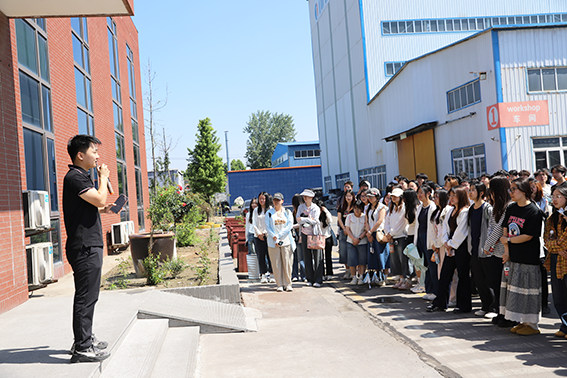
Tinhy and University of Jinan Celebrate Six Years of Industry–University Collaboration
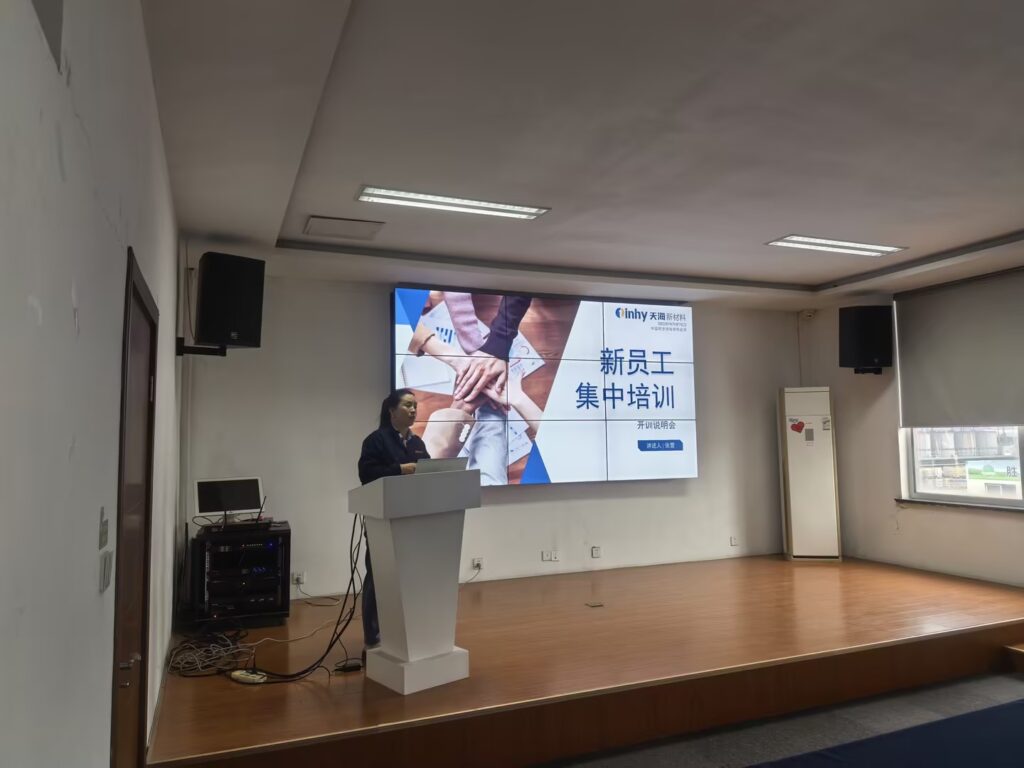
Empowering New Talent, Building the Future: Tinhy Successfully Conducts New Employee Orientation Training
Tinhy Conducts Comprehensive Emergency Drill to Strengthen Workplace Safety Defenses
Company Mid – Year Summary and Team – Building Activity Report
Is geomembrane a geotechnical engineering material?
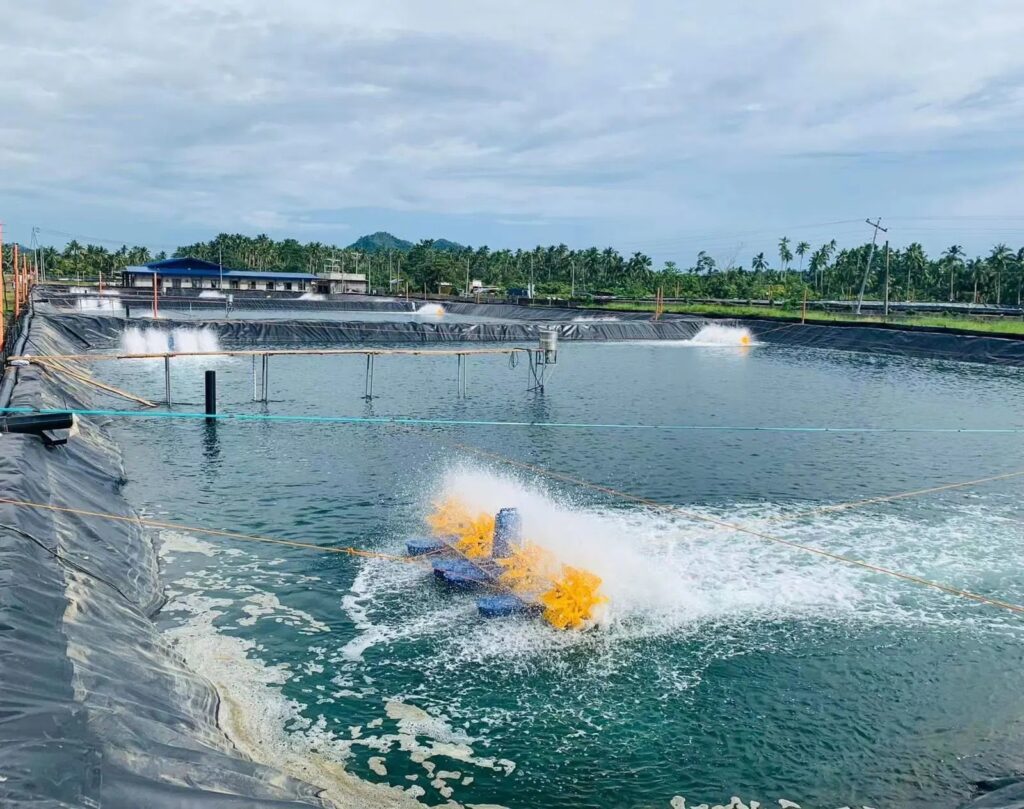
What are the application scenarios of geomembrane?
What are the functions of geotextiles?
Cómo elegir geomembrana de hdpe en proyectos de ingeniería
How to choose hdpe geomembrane in engineering projects
China’s Geotechnical Construction Materials Embrace New Opportunities
Tips for Moisture-Proof Storage of Geotextiles
Key Construction Points and Precautions for High-Density Polyethylene Geomembrane
what is pond lining material ?
What is geomembrane?
HDPE geomembrane construction plans and technical measures
What quality tests do HDPE geomembranes need to do?
Tinhy’s MDS® Drainage Solution
Installation Robots
Geo Textiles: Types, Applications, Benefits & Selection Guide
PP Woven Geotextiles: Properties, Applications & Selection Guide
Geogrid Price: Types, Cost Factors & Buying Guide
Geomembrane Manufacturers: 7 Companies to Consider for Your Project
Woven Geotextile Fabric Price: Specifications, Applications & Buying Guide
8 Geogrid Options for Retaining Walls: Types, Specifications & Buying Guide
LDPE Sheet 500 Micron Price: Cost Factors, Specifications & Buying Guide
7 Black PVC Pond Liner Options: Specifications & Buying Guide
8 Geotextile Suppliers to Consider in 2026: Products & Buying Guide
7 PVC Geomembrane Manufacturers: Products, Quality & Buying Guide
Should HDPE or PVC be used to install geomembrane in reservoirs?
What is the price of geomembrane?
Material characteristics of three different geomembranes
Esquema de construcción de geomembrana de HDPE y medidas técnicas
hdpe geomembrane pond liner in Congo (DRC)
How to lay and weld HDPE geomembrane?
HDPE geomembrane 0.2-4.0mm
HOME ABOUT PRODUCTS APPLICATION CONTENTUS RESOURCES
Home Resources Knowledge Base PP Woven Geotextiles: Properties, Applications & Selection Guide

PP Woven Geotextiles: Properties, Applications & Selection Guide
time:October 12, 2026 Views:38

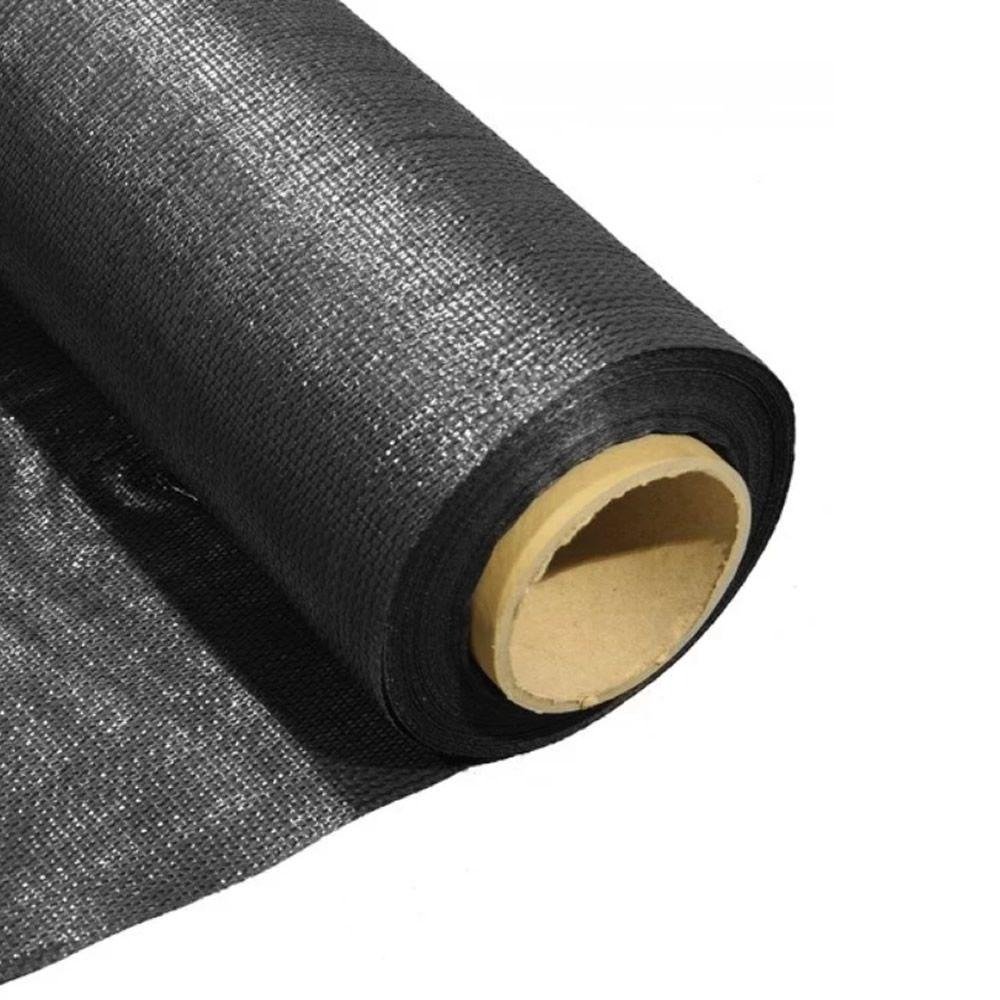
PP woven geotextiles are widely used in civil engineering projects that require soil separation, stabilization, and tensile reinforcement. Manufactured from polypropylene (PP) yarns or tapes woven into a stable fabric structure, these geosynthetics help manage interactions between soil and aggregate layers under construction and service loads.

From unpaved roads and construction access routes to embankments, industrial yards, and infrastructure projects, PP woven geotextiles offer a practical solution for improving the performance of soil and aggregate systems when selected according to project requirements.

However, not all woven geotextiles have the same properties. Yarn type, weaving structure, tensile strength, elongation, opening size, and installation conditions can all affect product performance.

In this guide, Tinhy Geosynthetics explains what PP woven geotextiles are, how they work, where they are used, and what buyers should consider when choosing a suitable product.

1. What Are PP Woven Geotextiles?

PP woven geotextiles are geosynthetic fabrics made by interlacing polypropylene tapes or yarns in two directions to form a stable, sheet-like material. The resulting structure provides tensile strength and dimensional stability for a range of civil engineering applications.

Polypropylene is commonly used because it is lightweight, resistant to many chemicals found in soil, and suitable for manufacturing durable woven fabrics.

Depending on the manufacturing process, PP woven geotextiles may use slit-film tapes, monofilaments, or multifilament yarns. Different structures offer different combinations of strength, opening characteristics, permeability, and cost.

How Do PP Woven Geotextiles Work?

PP woven geotextiles can perform several functions depending on their structure and the project design:

  • Separation: Helps prevent soil and aggregate layers from mixing.
  • Stabilization: Helps maintain aggregate layer integrity over weaker subgrades.
  • Reinforcement: Transfers tensile forces within the soil-geosynthetic system when designed for that purpose.
  • Filtration: Allows water to pass through while retaining soil particles when the fabric’s opening characteristics are compatible with the surrounding soil.
  • Erosion control: Can help protect soil in selected applications when used as part of an appropriate system.

A key consideration is that woven geotextiles are not interchangeable with every other geotextile type. Product selection should reflect the primary engineering function required.

2. Key Properties of PP Woven Geotextiles

Understanding the main technical properties helps engineers, contractors, and purchasing teams compare products more effectively.

2.1 Tensile Strength

Tensile strength indicates how much force a geotextile can withstand when pulled. It is particularly important in applications involving soil stabilization, reinforcement, and construction traffic.

The required strength depends on the subgrade condition, loading, aggregate characteristics, installation method, and design criteria. Buyers should compare machine direction (MD) and cross-machine direction (CD or XD) values rather than relying on a single headline strength figure.

2.2 Elongation

Elongation describes how much a fabric stretches under tensile loading. Different PP woven structures can have different elongation characteristics.

For reinforcement applications, the relationship between tensile strength and strain is important. Engineers should review the relevant tensile-strength curves and design requirements instead of selecting a product based only on its ultimate strength.

2.3 Separation and Stabilization Performance

When placed between subgrade soil and aggregate, a suitable woven geotextile helps limit intermixing caused by construction traffic and repeated loading.

Maintaining the separation layer can help preserve aggregate thickness and reduce contamination of the base material. Actual results depend on the soil conditions, aggregate gradation, traffic, drainage, and construction practices.

2.4 Opening Size and Water Permeability

Opening size and permeability are important when a geotextile must allow water to pass while retaining soil particles.

A woven fabric designed primarily for tensile strength may not provide the same filtration performance as a purpose-designed filtration geotextile. The apparent opening size, permeability, and surrounding soil gradation should therefore be assessed together.

2.5 Chemical and UV Resistance

Polypropylene generally offers good resistance to many chemicals encountered in typical soil environments. However, exposure conditions, temperature, and specific chemical concentrations should be evaluated for demanding applications.

Ultraviolet radiation can degrade exposed polypropylene over time. UV stabilization, storage conditions, and the length of exposure before burial should be considered during product selection and installation planning.

3. Common Applications of PP Woven Geotextiles

3.1 Road Construction and Base Stabilization

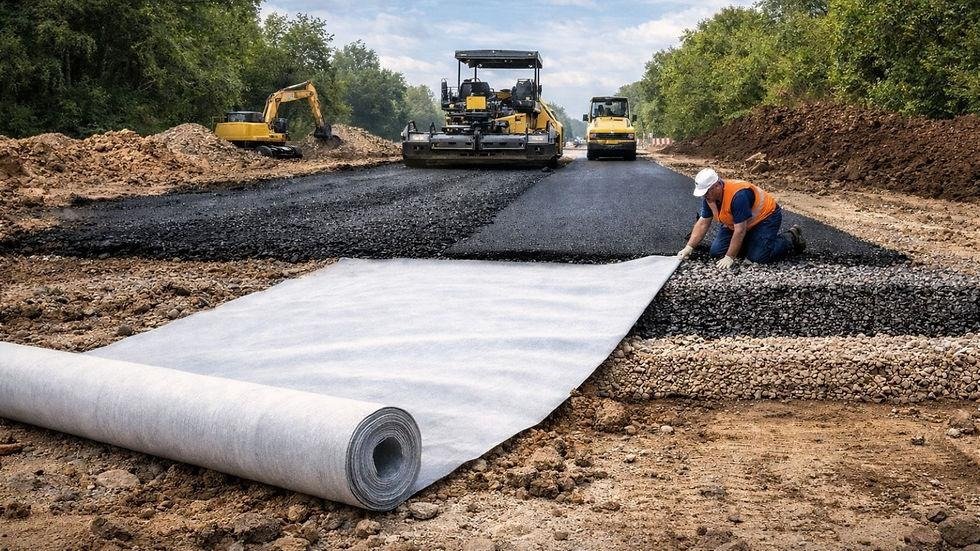
<Insert Image 2: PP Woven Geotextile for Road Construction>

In road construction, PP woven geotextiles are often installed between weak subgrade soil and granular base materials.

The fabric helps separate the layers and can contribute to more stable aggregate support under construction and traffic loads. It is used in selected applications involving rural roads, temporary access roads, construction routes, and other paved or unpaved road systems.

The required product strength and installation details should be determined from the project design and site conditions.

3.2 Mining Roads and Heavy-Duty Access Routes

Mining and industrial access roads may experience repeated heavy vehicle loading and challenging ground conditions.

A suitable woven geotextile can help limit the migration of fine soil into the aggregate layer and maintain separation during construction and service. Product selection should account for the expected loads, subgrade strength, aggregate size, and potential installation damage.

3.3 Embankments and Soil Reinforcement

Some high-strength woven geotextiles can be incorporated into engineered soil systems to help resist tensile forces.

Their suitability depends on the design method, required tensile capacity, long-term performance criteria, anchorage, and interaction with the surrounding soil. Not every PP woven geotextile is intended for structural reinforcement, so the technical data sheet and engineering design should be checked carefully.

3.4 Parking Areas and Industrial Yards

Parking areas, container yards, storage areas, and industrial platforms may require separation between the natural subgrade and imported aggregate.

PP woven geotextiles can be considered where their mechanical and hydraulic properties match the design requirements and the expected construction conditions.

3.5 Railway and Other Infrastructure Projects

Woven geotextiles may also be considered in selected railway, platform, and infrastructure applications. These projects often have specific requirements for strength, filtration, durability, and installation survivability.

The product should meet the applicable project specification rather than being selected solely because it is marketed for general road construction.

4. PP Woven Geotextile vs. Nonwoven Geotextile

PP woven geotextiles and nonwoven geotextiles serve overlapping but different purposes.

Comparison PP Woven Geotextile Nonwoven Geotextile
Structure Interlaced tapes or yarns Fibers bonded mechanically, thermally, or chemically
Common strength characteristics Often selected for tensile strength and dimensional stability Varies by fiber type, bonding method, and product grade
Separation Suitable for many soil-aggregate interfaces Also widely used for separation
Reinforcement Some grades are designed for reinforcement Generally requires application-specific evaluation
Filtration Depends on opening size and permeability Often available in structures suited to filtration
Drainage Depends on fabric structure and hydraulic properties Often used in filtration and drainage systems
Selection priority Tensile requirements, separation, and stabilization Filtration, protection, drainage, or separation requirements

Which should you choose?

Choose PP woven geotextile when the project requires a woven structure with suitable tensile properties and separation or stabilization performance. Consider nonwoven geotextile when filtration, cushioning, protection, or drainage-related characteristics are the main priorities.

In some engineered systems, the two types can be used together to perform different functions.

5. Important PP Woven Geotextile Specifications

When requesting quotations, buyers should compare complete technical data rather than product weight alone.

Parameter Why It Matters
Material Confirms whether the product uses polypropylene or another polymer
Mass per unit area (g/m²) Helps identify the product grade, but does not determine performance by itself
Tensile strength (MD/CD) Indicates tensile capacity in both principal directions
Elongation Describes deformation under tensile loading
Grab tensile strength Provides a measure of tensile behavior under the specified test method
Tear resistance Helps assess resistance to tearing
Puncture resistance Relevant to damage from aggregate and installation activities
Apparent opening size (AOS) Helps assess soil retention and filtration suitability
Permittivity or permeability Indicates water transmission characteristics under specified test conditions
UV resistance Relevant when the product may be exposed before installation or burial
Roll dimensions Affect transport, handling, overlap, and installation planning
Test standards Ensure that quoted values are measured using comparable methods

Values should be evaluated using the test methods and acceptance criteria specified for the project. Results from different test methods may not be directly comparable.

6. How to Select the Right PP Woven Geotextile

A systematic selection process can help reduce specification mismatches and unnecessary costs.

Step 1: Define the Main Function

Determine whether the primary requirement is separation, stabilization, reinforcement, filtration, or a combination of functions.

Step 2: Assess Site Conditions

Review the subgrade soil, soil strength, aggregate gradation, groundwater conditions, construction equipment, and expected traffic loads.

Step 3: Establish Technical Requirements

Identify the required tensile strength, elongation, puncture resistance, opening size, permeability, and durability criteria. For engineered reinforcement applications, follow the project-specific design.

Step 4: Check the Test Methods

Confirm that the manufacturer’s reported properties correspond to the standards required by the specification. Request the relevant technical data sheet and test reports where necessary.

Step 5: Review Roll Dimensions and Installation Details

Consider roll width, roll length, overlap requirements, site access, storage, and handling. The installation plan should minimize unnecessary seams and protect the material from damage.

Step 6: Compare Total Delivered Cost

Compare quotations using equivalent specifications and include packaging, freight, duties, handling, and any project-specific inspection or documentation costs.

The lowest price per square meter is not necessarily the most economical option if the product does not meet the design requirements.

7. Common Mistakes to Avoid

Selecting by weight alone. Two products with the same mass per unit area may have different tensile strength, elongation, and opening characteristics.

Ignoring filtration requirements. A fabric selected for strength may not retain the site soil adequately in a filtration-critical application.

Using a general-purpose product for structural reinforcement. Reinforcement requires appropriate design data and long-term performance considerations.

Overlooking installation damage. Sharp aggregate, poor handling, and unsuitable placement practices can affect the installed product.

Leaving rolls exposed for too long. Follow the manufacturer’s storage and UV-exposure recommendations.

Comparing quotations with different test methods. Confirm that the values are reported under comparable standards and conditions.

8. Why Source PP Woven Geotextiles from Tinhy Geosynthetics?

Tinhy Geosynthetics supplies geosynthetic materials for civil engineering and infrastructure projects, including woven and nonwoven geotextiles and other complementary geosynthetic products.

When sourcing PP woven geotextiles, project buyers should focus on specification matching, manufacturing consistency, product documentation, and delivery requirements.

Tinhy can work with buyers to clarify key purchasing details, including:

  • Required material and mass per unit area.
  • Tensile properties and applicable test standards.
  • Roll width, roll length, and order quantity.
  • Intended application and site conditions.
  • Packaging, shipping destination, and delivery schedule.

For projects involving multiple geosynthetic layers, the required product functions should be identified clearly so that each material can be evaluated against its intended role.

Contact Tinhy Geosynthetics with your project specifications to discuss suitable geotextile options and request product information.

9. Frequently Asked Questions

What does PP stand for in PP woven geotextiles?

PP stands for polypropylene, a thermoplastic polymer commonly used to manufacture woven geotextile tapes and yarns.

What are PP woven geotextiles used for?

Common uses include soil-aggregate separation, road and access-route stabilization, selected reinforcement applications, industrial yards, and other civil engineering projects. Suitability depends on the product properties and design requirements.

Are PP woven geotextiles suitable for road construction?

Yes. They are used in many road construction and stabilization systems, particularly where separation and appropriate tensile properties are required. The correct grade should be selected based on subgrade conditions, traffic loads, aggregate characteristics, and project specifications.

Are woven geotextiles better than nonwoven geotextiles?

Neither type is universally better. Woven geotextiles are often selected for tensile and stabilization requirements, while nonwoven products are frequently chosen for filtration, drainage, and protection. The intended function should guide the selection.

How do I compare PP woven geotextile suppliers?

Compare the technical data sheet, test methods, product consistency, available roll dimensions, quality documentation, delivery terms, and total delivered cost. Confirm that the product meets the project’s specifications before placing an order.

What information is needed to request a quotation?

Provide the intended application, required technical properties, roll dimensions, estimated quantity, destination country or port, and any applicable standards. Drawings or project specifications can also help suppliers evaluate the request.

Conclusion

PP woven geotextiles are important materials for civil engineering projects that require soil separation, stabilization, and selected reinforcement functions. Their performance depends on the woven structure, tensile properties, opening characteristics, durability, and compatibility with site conditions.

For engineers, contractors, and international buyers, the most effective selection process starts with the project requirements—not simply product weight or unit price. Reviewing technical specifications, test methods, installation conditions, and total delivered cost helps ensure that the selected geotextile is appropriate for its intended application.

Tinhy Geosynthetics supports project buyers with geosynthetic product options and technical information to help them evaluate materials for their engineering requirements. Contact our team to discuss your PP woven geotextile needs.

Knowledge Base
Share:
info@tinhygeosynthetics.com Bai Jinxi
Consultation

    Get The Latest Product Prices

    Your inquiries are welcomed at any time and please feel free to contact us via email, phone calls, and online chatbox on our site.

    We will definitely give you a reply ASAP after we receive your messages.

      0/180