Resources
Company News
Industry News
Knowledge Base
Project Cases
Innovation
Team Power Fuels TINHY’s Global Geosynthetics Solutions
Tinhy and University of Jinan Celebrate Six Years of Industry–University Collaboration

Empowering New Talent, Building the Future: Tinhy Successfully Conducts New Employee Orientation Training

Tinhy Conducts Comprehensive Emergency Drill to Strengthen Workplace Safety Defenses
Company Mid – Year Summary and Team – Building Activity Report
Is geomembrane a geotechnical engineering material?
What are the application scenarios of geomembrane?
What are the functions of geotextiles?
Cómo elegir geomembrana de hdpe en proyectos de ingeniería
How to choose hdpe geomembrane in engineering projects
China’s Geotechnical Construction Materials Embrace New Opportunities
Tips for Moisture-Proof Storage of Geotextiles
Key Construction Points and Precautions for High-Density Polyethylene Geomembrane
what is pond lining material ?
What is geomembrane?
HDPE geomembrane construction plans and technical measures

What quality tests do HDPE geomembranes need to do?
Tinhy’s MDS® Drainage Solution
Installation Robots
8 Geogrid Options for Retaining Walls: Types, Specifications & Buying Guide
LDPE Sheet 500 Micron Price: Cost Factors, Specifications & Buying Guide
7 Black PVC Pond Liner Options: Specifications & Buying Guide
8 Geotextile Suppliers to Consider in 2026: Products & Buying Guide
7 PVC Geomembrane Manufacturers: Products, Quality & Buying Guide
6 HDPE Pond Liner Suppliers: Products, Quality & Buying Guide
10 Geomembrane Options: Types, Manufacturers & Buying Guide
6 LLDPE Geomembrane Manufacturers: Products, Quality & Buying Guide
7 Best Geotextile Manufacturers: Products, Quality & Buying Guide
Woven Geotextile Fabric Price: Cost Guide & Buying Factors
Should HDPE or PVC be used to install geomembrane in reservoirs?
What is the price of geomembrane?
Material characteristics of three different geomembranes
Esquema de construcción de geomembrana de HDPE y medidas técnicas
hdpe geomembrane pond liner in Congo (DRC)
How to lay and weld HDPE geomembrane?
HDPE geomembrane 0.2-4.0mm
HOME ABOUT PRODUCTS APPLICATION CONTENTUS RESOURCES
Home Resources Knowledge Base 8 Geogrid Options for Retaining Walls: Types, Specifications & Buying Guide

8 Geogrid Options for Retaining Walls: Types, Specifications & Buying Guide

time:September 30, 2026 Views:6

Geogrid-reinforced retaining walls are widely used in mechanically stabilized earth (MSE) systems, reinforced soil structures, slopes, road infrastructure, landscaping, and other earth-retaining applications.

A geogrid works together with compacted soil or aggregate to create a reinforced soil mass. Its open-aperture structure allows interaction between the reinforcement and surrounding fill, helping transfer tensile forces and improve the stability of the reinforced zone.

However, not every geogrid is suitable for every retaining wall.

Wall height, soil conditions, reinforcement direction, facing system, surcharge loads, drainage, design life, and construction conditions all influence the required geogrid properties.

This guide reviews 8 geogrid options for retaining walls, explains the main specifications buyers should compare, and provides a practical framework for selecting geogrid for residential, commercial, infrastructure, and industrial projects.

Important: Geogrid selection and retaining wall design should be based on project-specific engineering calculations. FHWA guidance for MSE walls considers wall geometry, soil properties, reinforcement type, facing, stability, connection, settlement, and construction sequence rather than selecting reinforcement from tensile strength alone.

What Is a Geogrid Retaining Wall?

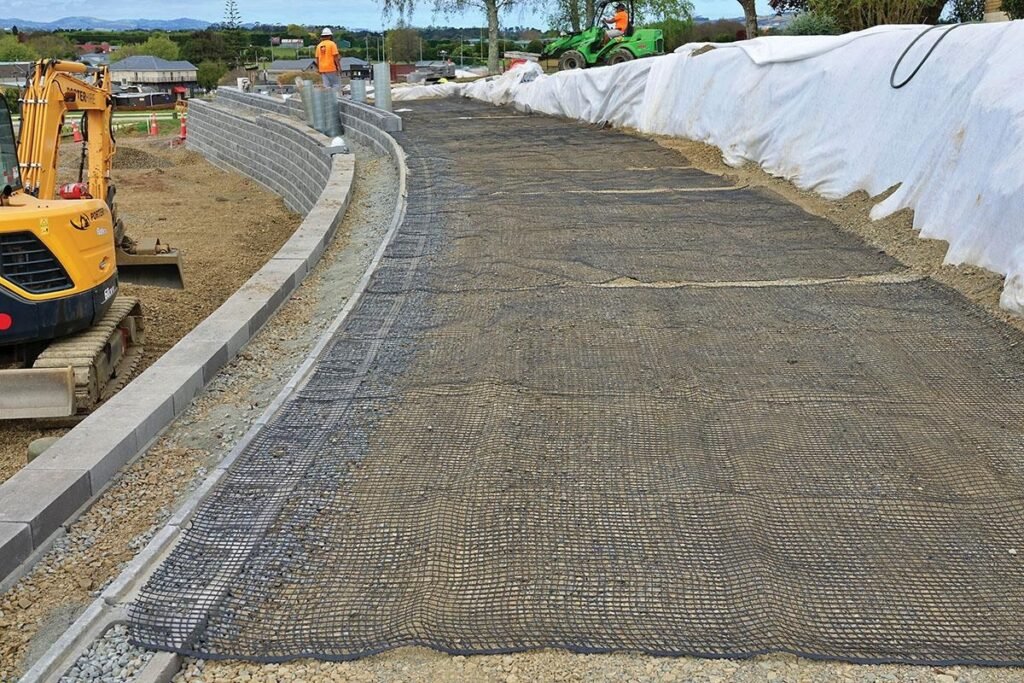
A geogrid retaining wall is a reinforced soil structure in which layers of geogrid are installed within compacted backfill behind a wall facing.

The geogrid interacts with the surrounding soil and aggregate, creating a reinforced soil mass that can resist tensile forces.

A typical system includes:

  • Wall facing
  • Compacted reinforced fill
  • Geogrid reinforcement
  • Drainage layer
  • Retained soil
  • Foundation soil

FHWA describes MSE walls as retaining structures consisting of facing and selected fill reinforced with embedded reinforcement elements. The interaction between soil and reinforcement creates a reinforced block capable of carrying significant loads and accommodating movement.

Typical Applications

Geogrid-reinforced retaining walls can be used for:

  • Residential landscaping walls
  • Commercial development
  • Highway and road embankments
  • Bridge approaches
  • Railway infrastructure
  • Industrial platforms
  • Reinforced slopes
  • Terraced landscapes
  • Erosion-control structures

Tinhy also identifies retaining walls, slopes, roads, railways, embankments, and earthworks among common geogrid applications.

8 Geogrid Options for Retaining Walls

The following products represent different reinforcement approaches and product configurations rather than an objective ranking.

1. Tensar UX Series

Tensar UX geogrids are uniaxial reinforcement products designed for applications where the principal tensile force is concentrated in one direction.

The source material identifies UX1600HS and UX3300 as high-strength retaining-wall reinforcement products, using high-tenacity polyester yarn with a polymer coating.

Typical characteristics

  • Uniaxial reinforcement
  • Polyester-based structure
  • High tensile capacity
  • Open aperture structure
  • Designed for soil reinforcement
  • Suitable for engineered retaining-wall systems

For a retaining wall, the important question is not simply the ultimate tensile strength but the available design strength after the applicable reduction factors.

2. Polypropylene Biaxial Geogrid

Biaxial polypropylene geogrids provide reinforcement in both principal directions.

The source material describes extruded and punched polypropylene geogrids with square apertures and strength ranges intended for residential and medium-scale reinforcement applications.

Key characteristics

  • Polypropylene construction
  • Biaxial reinforcement
  • Square apertures
  • Good soil interaction
  • Lightweight and easy to handle
  • Suitable for selected retaining-wall and soil-stabilization applications

Biaxial geogrids can be useful where reinforcement is required in two directions rather than primarily along one tensile axis.

3. StrataGrid Geogrid

StrataGrid products are polyester-based coated geogrids designed for soil reinforcement.

The source material highlights their use in situations involving challenging or marginal fill conditions.

Key characteristics

  • High-tenacity polyester
  • Polymer coating
  • Uniaxial reinforcement configurations
  • Designed for soil interaction
  • Available in different strength classes

When poor foundation or backfill conditions are present, reinforcement selection should be based on geotechnical design rather than simply increasing product strength.

4. HUESKER Fortrac High-Strength Series

Fortrac is a high-strength geogrid system based on coated high-tenacity polyester yarns.

The source material identifies high-strength Fortrac products for demanding retaining walls and reinforced soil structures.

Key characteristics

  • High-strength polyester
  • Polymer-coated yarns
  • High tensile capacity
  • High junction efficiency
  • Suitable for demanding reinforcement applications
  • Different strength levels available

For tall walls, steep slopes, or structures exposed to significant surcharge loads, long-term design strength and creep behavior are particularly important.

5. MIRAFI HP Series

MIRAFI HP geogrids are woven polyester reinforcement products.

The source material describes HP570–HP665 as polyester geogrids with open apertures designed for soil reinforcement.

Key characteristics

  • High-tenacity polyester
  • Woven structure
  • Open apertures
  • Good soil interaction
  • Designed for reinforcement applications
  • Suitable for selected retaining-wall systems

When comparing woven polyester geogrids, buyers should examine tensile properties, creep behavior, coating, installation damage resistance, and long-term design strength.

6. StrataGrid Mid-Range Series

Mid-range polyester geogrids provide another option for residential and commercial retaining-wall projects where the design does not require the highest reinforcement class.

Rather than selecting a product simply because it has a higher ultimate tensile strength, engineers should determine the required long-term design strength (LTDS) for the project.

Important factors include:

  • Wall height
  • Reinforcement spacing
  • Backfill properties
  • Surcharge
  • Foundation conditions
  • Design life
  • Installation damage
  • Creep
  • Durability

7. HUESKER Fortrac R Series

Fortrac R products are another polyester reinforcement option for reinforced soil structures, including steep and wrapped-face configurations.

The source material emphasizes high junction efficiency and use in steep or vegetated retaining-wall systems.

Potential advantages

  • High-strength polyester
  • Coated reinforcement
  • Strong soil interaction
  • Suitable for steep reinforcement geometries
  • Compatible with wrapped-face concepts

For vegetated or wrapped-face walls, the facing arrangement and geogrid connection details should be considered together during design.

8. Tinhy Geogrid

Tinhy Geosynthetics provides geogrid products as part of its reinforcement and stabilization product range.

Its current geogrid portfolio includes plastic geogrids, fiberglass geogrids, steel-plastic geogrids, and warp-knitting polyester geogrids, providing different reinforcement approaches for civil engineering and soil stabilization projects.

Tinhy’s geogrid product information identifies ASTM, ISO, EN, GB/T, GOST, GM-13 and GM-42 among its listed testing standards.

For buyers, Tinhy can provide project-specific geogrid options based on:

  • Geogrid type
  • Tensile strength
  • Reinforcement direction
  • Aperture structure
  • Roll dimensions
  • Required testing standards
  • Project quantity
  • Installation requirements

This makes specification-based purchasing more useful than choosing a geogrid based only on a general product category.

Geogrid Types for Retaining Walls

Geogrids can be classified according to both material and reinforcement direction.

Type Common Material Main Characteristics Typical Consideration
Uniaxial geogrid PET / PP / HDPE Higher reinforcement in one direction Retaining walls and steep slopes
Biaxial geogrid PP / PET Reinforcement in two directions Soil stabilization and selected walls
Fiberglass geogrid Fiberglass High stiffness and dimensional stability Selected reinforcement applications
Steel-plastic geogrid Steel + polymer High tensile capacity Heavy-duty reinforcement
Polyester geogrid PET High tensile strength and low creep characteristics Engineered soil reinforcement
Plastic geogrid PP / HDPE Lightweight and corrosion-resistant Roads, slopes and soil stabilization

Tinhy’s product information also identifies plastic, steel-plastic, metal, fiberglass, and vegetation-related geogrid configurations as different geogrid categories.

Key Geogrid Specifications to Compare

1. Tensile Strength

Tensile strength is one of the first specifications buyers usually compare.

However, the ultimate tensile strength alone should not determine product selection.

Engineers should also consider:

  • Tensile strength at specified strain
  • Long-term design strength
  • Creep
  • Installation damage
  • Durability
  • Temperature and environmental conditions

2. Long-Term Design Strength

The LTDS (Long-Term Design Strength) is particularly important for permanent retaining walls.

The design strength can be reduced from the short-term tensile capacity because of factors such as:

  • Creep
  • Installation damage
  • Durability
  • Chemical exposure
  • Biological effects
  • Temperature

The source material also emphasizes these reduction factors when discussing geogrid retaining-wall design.

3. Junction Efficiency

For geogrids, the junction between longitudinal and transverse elements is important because it transfers loads through the grid structure.

A high junction efficiency can contribute to effective load transfer, but it should be evaluated together with the complete product test data.

4. Aperture Size and Shape

The aperture must interact appropriately with the selected backfill.

The relationship between:

geogrid aperture + aggregate size + soil properties

affects mechanical interlock and reinforcement performance.

Therefore, a larger tensile strength value does not automatically mean better soil interaction.

5. Polymer and Coating

Common geogrid materials include:

  • Polypropylene
  • Polyester
  • HDPE
  • Fiberglass
  • Steel-polymer composites

Coatings can provide additional protection and influence durability and installation behavior.

How to Select Geogrid for a Retaining Wall

There is no universal geogrid specification that works for every wall.

Start with the project design.

Step 1: Define Wall Geometry

Determine:

  • Wall height
  • Wall inclination
  • Reinforced soil zone
  • Facing type
  • Reinforcement spacing
  • Available setback

Step 2: Evaluate Soil Conditions

Review:

  • Backfill type
  • Internal friction angle
  • Unit weight
  • Foundation soil
  • Retained soil
  • Groundwater
  • Settlement conditions

FHWA’s MSE wall methodology considers both soil parameters and wall parameters when establishing the design.

Step 3: Calculate Required Reinforcement

The required geogrid depends on:

  • Internal stability
  • External stability
  • Pullout resistance
  • Connection strength
  • Sliding
  • Overturning
  • Bearing
  • Global stability
  • Settlement

FHWA’s guidance treats MSE design as a multi-step process rather than a simple product-strength comparison.

Step 4: Check Long-Term Performance

For permanent walls, review:

  • Creep reduction
  • Installation damage reduction
  • Durability reduction
  • Chemical resistance
  • UV exposure where applicable
  • Design life

Step 5: Confirm Drainage

Drainage is an essential part of retaining-wall design.

A geogrid does not replace a drainage system.

Depending on the wall design, drainage may include:

  • Free-draining backfill
  • Drainage aggregate
  • Drainage pipe
  • Geotextile filter
  • Drainage composite
  • Outlet or weep system

Tinhy’s geotextile guidance also notes that nonwoven geotextiles can be used behind retaining walls with drainage materials to allow water movement while limiting soil migration.

Geogrid Reinforcement Length and Spacing

Reinforcement length and vertical spacing should be calculated from the wall design.

They should not be selected simply from a general rule.

FHWA guidance includes reinforcement length, vertical spacing, soil-reinforcement interaction, pullout resistance, connection behavior, and external stability as parts of MSE wall design.

The source article mentions a preliminary reinforcement length of approximately 0.7H in the context of FHWA methodology, but this should not be treated as a universal installation rule.

For an actual project, the final reinforcement length and spacing should come from the project-specific engineering design.

Common Geogrid Retaining Wall Mistakes

1. Selecting Only by Tensile Strength

A product with higher ultimate strength is not automatically the correct product.

LTDS, creep, installation damage, durability, soil interaction, and connection strength also matter.

2. Ignoring Soil Conditions

The same geogrid may not be appropriate for every soil.

Backfill and foundation conditions must be evaluated during design.

3. Using Insufficient Embedment

The reinforcement must extend far enough into the reinforced soil zone to develop the required resistance.

4. Poor Compaction

Improper compaction can affect the behavior of the reinforced soil mass and the interaction between soil and geogrid.

5. Ignoring Drainage

Water accumulation can increase pressure behind a retaining wall.

A reinforcement system should therefore be considered together with the drainage design.

6. Installing Geogrid With Excessive Slack

The geogrid should be installed according to the project specifications so that its intended reinforcement behavior can be developed.

Questions to Ask a Geogrid Supplier

Before placing an order, ask the supplier for:

  1. What is the product’s tensile strength?
  2. What is the tensile strength at the specified strain?
  3. What is the LTDS?
  4. What reduction factors are used?
  5. What is the junction efficiency?
  6. What is the aperture size?
  7. What polymer is used?
  8. Is the product coated?
  9. What testing standards are available?
  10. Can the supplier provide a technical data sheet?
  11. Are independent laboratory reports available?
  12. Can the product be customized to the project specification?
  13. What are the roll dimensions?
  14. What is the production lead time?
  15. What export documentation is available?

Geogrid vs Geotextile for Retaining Walls

Geogrids and geotextiles can both be used in earth-retaining systems, but their primary functions are different.

Property Geogrid Geotextile
Structure Open grid Textile sheet
Main function Reinforcement Separation, filtration, drainage, protection
Soil interaction Mechanical interlock Friction and filtration
Primary load function Tensile reinforcement Application-dependent
Retaining wall use Reinforced soil Often drainage/separation/protection
Typical material PP, PET, HDPE, fiberglass PP or PET

In some retaining-wall systems, both materials can be used together.

For example:

Geogrid → reinforcement

Geotextile → separation / filtration / drainage support

Tinhy’s current technical content similarly distinguishes geogrid primarily as a reinforcement material and geotextile as a material for separation, filtration, drainage, and protection.

Why Work With a Geogrid Manufacturer?

Buying directly from a manufacturer can be useful when the project requires:

  • Customized specifications
  • Large quantities
  • Multiple geosynthetic products
  • Technical documentation
  • Factory testing
  • Export packaging
  • Consistent repeat orders

For international projects, it can also simplify communication between the product specification and the manufacturing requirements.

Tinhy Geosynthetics supplies geogrids alongside geotextiles, geomembranes, geocells, geonets and other geosynthetic materials, allowing buyers to source multiple components for a reinforced soil system from one supplier.

Conclusion

Choosing a geogrid for a retaining wall should begin with the engineering requirements, not a generic “best geogrid” ranking.

Wall height, soil properties, surcharge, reinforcement spacing, facing, drainage, connection strength, installation conditions, and design life all affect the required product.

When comparing geogrids, focus on:

  • Tensile strength
  • Tensile strength at specified strain
  • LTDS
  • Creep resistance
  • Installation damage
  • Durability
  • Junction efficiency
  • Aperture structure
  • Soil interaction
  • Testing documentation

For residential landscaping, commercial retaining walls, reinforced slopes, roads, and larger MSE structures, the appropriate geogrid should be selected from the project-specific design.

Tinhy Geosynthetics offers multiple geogrid configurations and other geosynthetic materials for reinforcement and stabilization projects, with product specifications and testing standards available for project-based evaluation.

Knowledge Base
Share:
info@tinhygeosynthetics.com Bai Jinxi
Consultation

    Get The Latest Product Prices

    Your inquiries are welcomed at any time and please feel free to contact us via email, phone calls, and online chatbox on our site.

    We will definitely give you a reply ASAP after we receive your messages.

      0/180