Resources
Company News
Industry News
Knowledge Base
Project Cases
Innovation
Team Power Fuels TINHY’s Global Geosynthetics Solutions
Tinhy and University of Jinan Celebrate Six Years of Industry–University Collaboration
Empowering New Talent, Building the Future: Tinhy Successfully Conducts New Employee Orientation Training
Tinhy Conducts Comprehensive Emergency Drill to Strengthen Workplace Safety Defenses
Company Mid – Year Summary and Team – Building Activity Report
Is geomembrane a geotechnical engineering material?
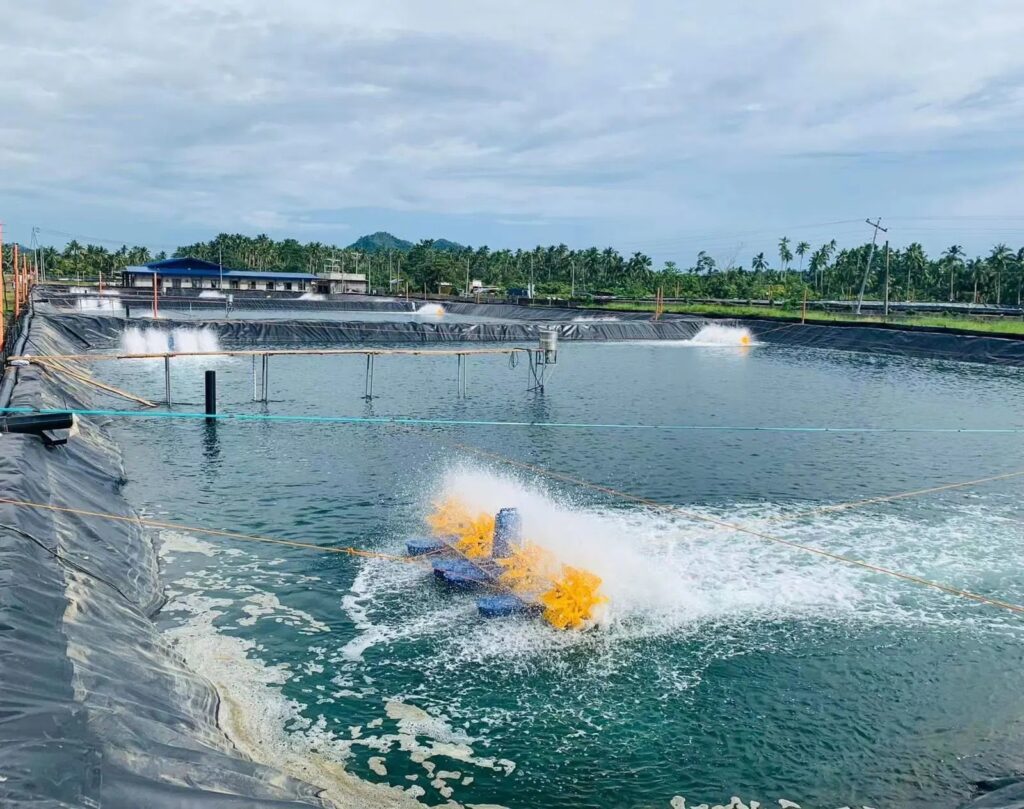
What are the application scenarios of geomembrane?
What are the functions of geotextiles?
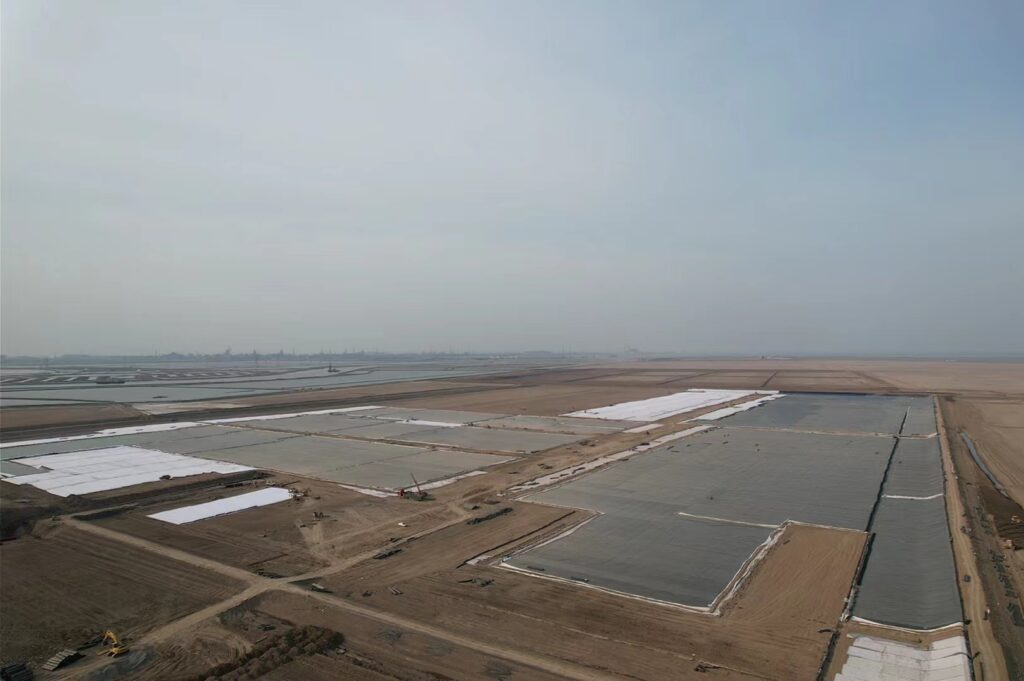
Cómo elegir geomembrana de hdpe en proyectos de ingeniería
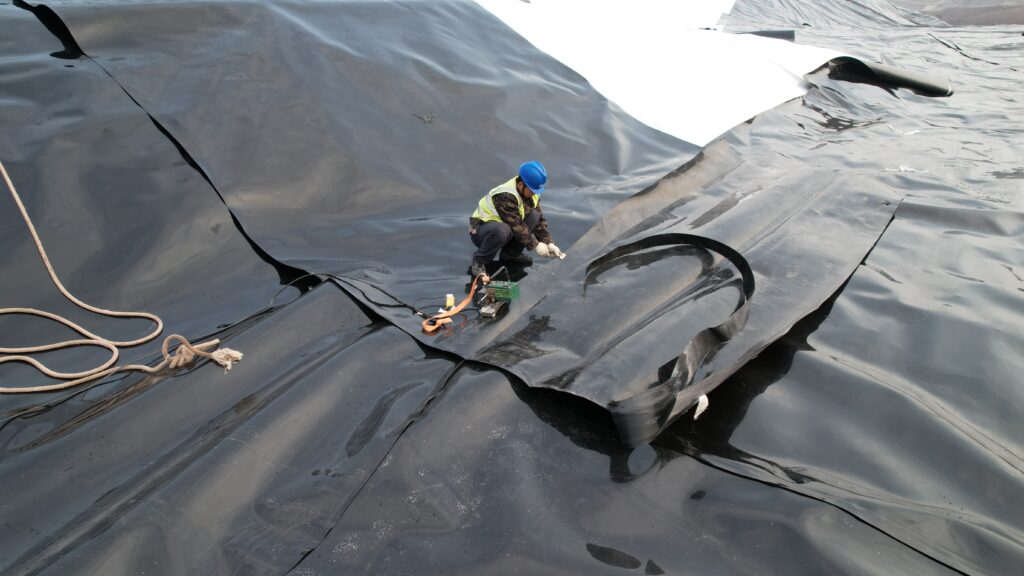
How to choose hdpe geomembrane in engineering projects
China’s Geotechnical Construction Materials Embrace New Opportunities
Tips for Moisture-Proof Storage of Geotextiles
Key Construction Points and Precautions for High-Density Polyethylene Geomembrane
what is pond lining material ?
What is geomembrane?
HDPE geomembrane construction plans and technical measures
What quality tests do HDPE geomembranes need to do?
Tinhy’s MDS® Drainage Solution
Installation Robots
HDPE Liner Installation: A Step-by-Step Guide for Geomembrane Projects
The 10 Best Geotextile 200g Review: Properties, Applications & Buying Guide
The 8 Best Black Pond Liners Review: Materials, Performance & Selection Guide
How to Choose the Right HDPE Liner for Tailings Dams
The 7 Best Reservoir Liner Materials for Water Containment Projects
Top 8 HDPE Pond Liner Manufacturers in the World
Geogrid vs Geotextile: Differences, Applications & How to Choose
Filament Geotextile vs Staple Fiber Geotextile: Key Differences and Applications
The 6 Best Geomat Manufacturers in 2026: Complete Comparison Guide
How to Choose the Right Waterproof Geomembrane for Your Project?
Should HDPE or PVC be used to install geomembrane in reservoirs?
What is the price of geomembrane?
Material characteristics of three different geomembranes
Esquema de construcción de geomembrana de HDPE y medidas técnicas
hdpe geomembrane pond liner in Congo (DRC)
How to lay and weld HDPE geomembrane?
HDPE geomembrane 0.2-4.0mm
HOME ABOUT PRODUCTS APPLICATION CONTENTUS RESOURCES
Home Resources Knowledge Base HDPE Liner Installation: A Step-by-Step Guide for Geomembrane Projects

HDPE Liner Installation: A Step-by-Step Guide for Geomembrane Projects

time:September 09, 2026 Views:4

High-density polyethylene (HDPE) geomembrane liners are widely used as impermeable barriers in landfills, wastewater treatment facilities, mining operations, agricultural ponds, reservoirs, aquaculture projects, and other containment systems.

However, selecting a high-quality HDPE liner is only part of a successful containment project. Proper site preparation, liner deployment, seaming, anchoring, inspection, and protection are equally important. Even a well-manufactured geomembrane can perform poorly if it is damaged during installation or if seams are not properly welded and tested.

This guide from Tinhy Geosynthetics explains the main steps involved in HDPE liner installation, from site assessment and subgrade preparation to welding, testing, and final documentation.

Important: Installation requirements vary according to project design, liner thickness, site conditions, climate, slope geometry, and applicable specifications. Always follow the project engineer’s drawings and the geomembrane manufacturer’s installation recommendations.

Table of Contents

1. What Is an HDPE Liner?

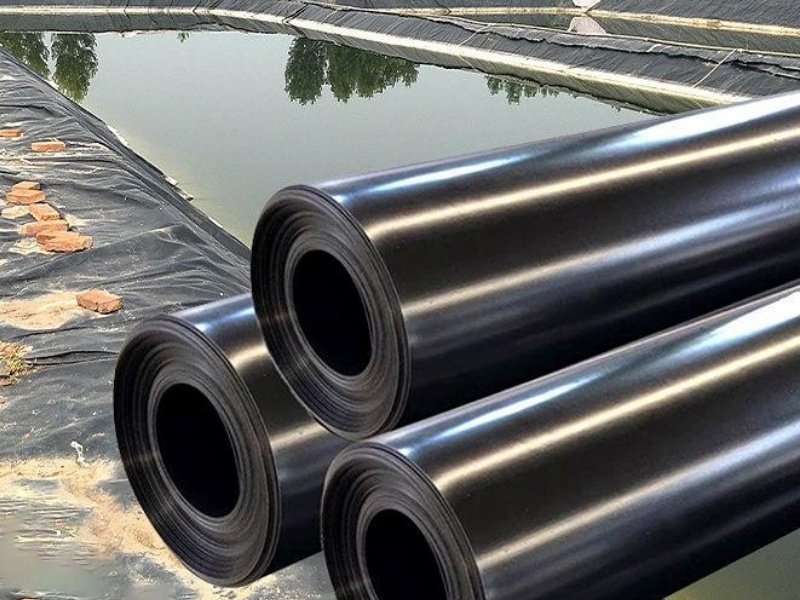
An HDPE liner is an impermeable geomembrane manufactured primarily from high-density polyethylene resin. It is designed to provide a low-permeability barrier between contained materials and the surrounding soil or groundwater.

HDPE geomembranes are valued for their:

  • Low permeability
  • Chemical resistance
  • Tensile and puncture resistance
  • UV and weathering resistance
  • Long-term durability
  • Weldability
  • Relatively stable performance across demanding containment applications

Common HDPE geomembrane thicknesses range from approximately 0.5 mm to 3.0 mm, although the appropriate thickness depends on the project.

Common Applications of HDPE Liners

HDPE geomembranes are widely used for:

  • Landfill liners and caps
  • Wastewater treatment ponds
  • Agricultural ponds and reservoirs
  • Aquaculture ponds
  • Mining heap leach pads and tailings facilities
  • Industrial wastewater lagoons
  • Stormwater retention systems
  • Canals and water conservation projects
  • Oil and gas containment
  • Secondary containment systems

For demanding projects, liner selection should consider more than thickness alone. Resin quality, mechanical properties, carbon black dispersion, surface structure, welding characteristics, and project-specific testing requirements should also be evaluated.

2. Types of HDPE Geomembrane Liners

Different HDPE geomembrane surfaces and configurations are available for different site conditions.

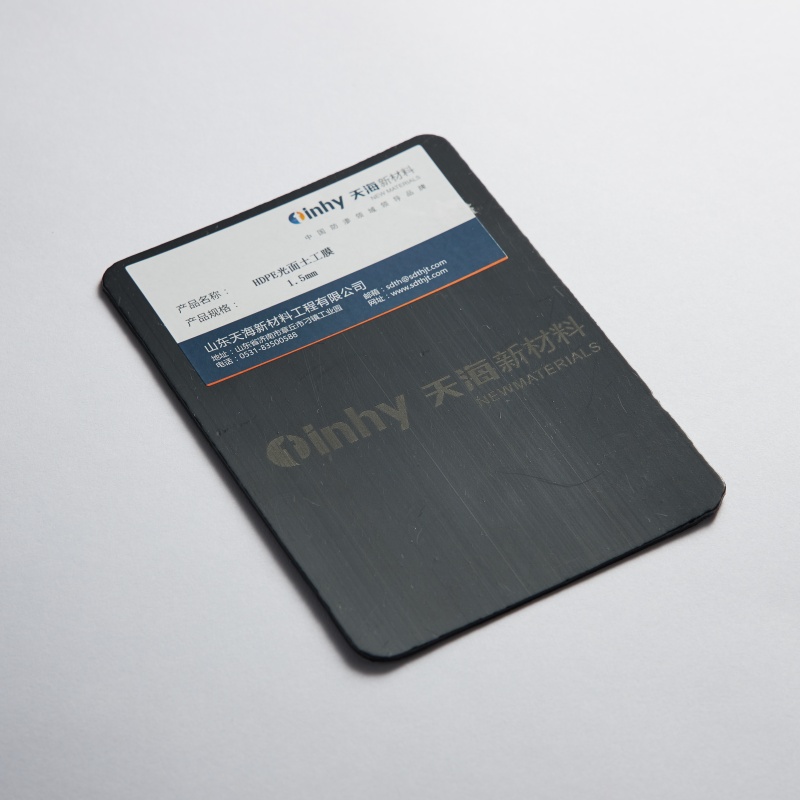
2.1 Smooth HDPE Geomembrane

Smooth HDPE geomembranes have a relatively low-friction surface and are commonly selected for flat or gently sloped areas.

Typical applications include:

  • Landfill bottom liners
  • Water reservoirs
  • Agricultural ponds
  • Aquaculture ponds
  • Wastewater lagoons
  • Horizontal containment areas

Smooth geomembranes are also widely used where easy deployment and efficient seaming are priorities.

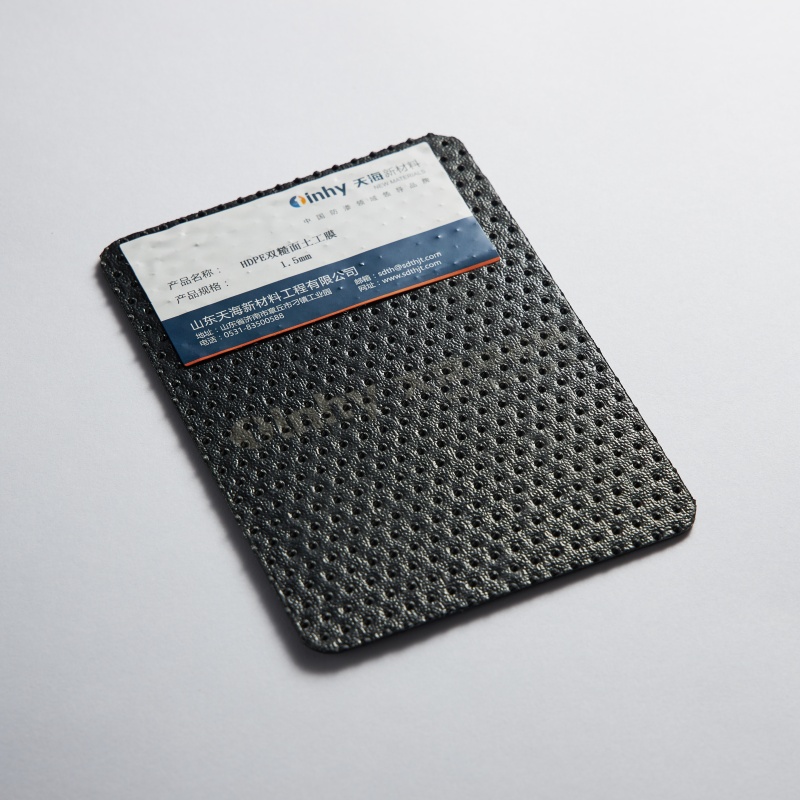
2.2 Textured HDPE Geomembrane

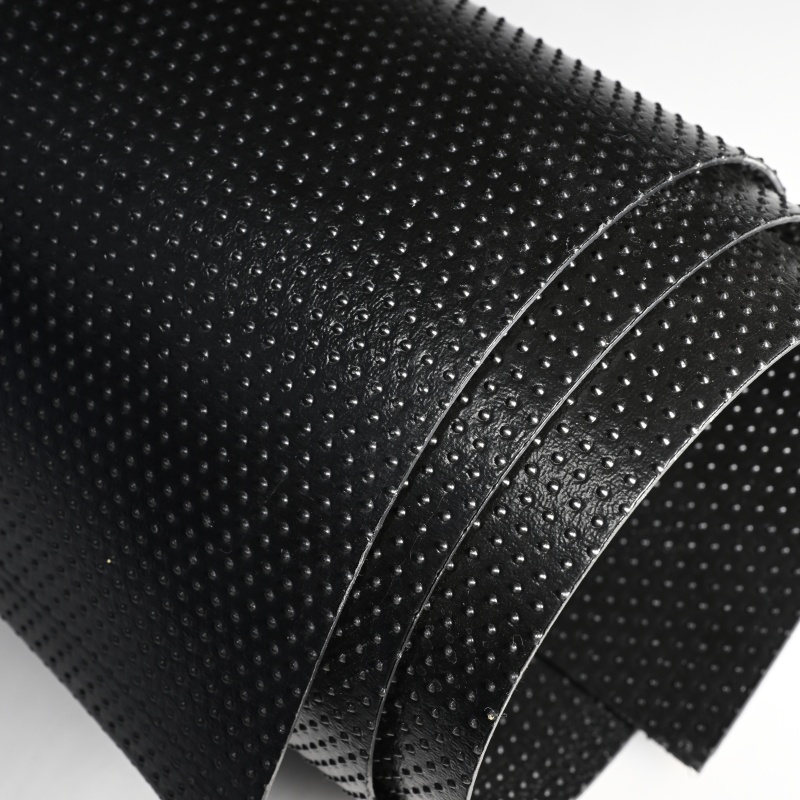
Textured or rough-surface HDPE geomembranes provide greater interface friction than smooth geomembranes.

They are particularly useful where slope stability is an important design consideration.

Typical applications include:

  • Landfill side slopes
  • Mining facilities
  • Heap leach pads
  • Steep containment slopes
  • Composite liner systems
  • Projects requiring improved soil-to-geomembrane friction

For slope applications, the appropriate texture should be determined from the project’s interface shear analysis rather than simply selecting a textured liner based on slope angle.

2.3 Conductive HDPE Geomembrane

Conductive or electrically conductive geomembranes are designed to support electrical leak-location testing when the project requires it.

They can be useful in critical containment systems where detecting small defects after installation is an important part of quality assurance.

2.4 White or Reflective HDPE Geomembrane

White-surface or reflective geomembranes can reduce solar heat absorption compared with conventional black geomembranes.

They may be considered for projects where surface temperature, thermal expansion, and liner handling under strong sunlight are significant concerns.

3. Step-by-Step HDPE Liner Installation

A successful installation normally involves several interconnected stages:

  1. Site assessment and planning
  2. Subgrade preparation
  3. Measuring and panel layout
  4. Liner deployment
  5. Seaming and welding
  6. Anchoring
  7. Inspection and testing
  8. Installation of protective or cover layers
  9. Final inspection and documentation

Each stage should be completed carefully before moving to the next.

3.1 Site Assessment and Installation Planning

Before the HDPE liner arrives on site, the installation team should review the project design and site conditions.

Key tasks include:

  • Review engineering drawings and liner specifications
  • Confirm required geomembrane thickness and surface type
  • Evaluate slopes and subgrade conditions
  • Identify anchor trench locations
  • Plan panel dimensions and seam directions
  • Identify penetrations, pipe connections, and structures
  • Determine access routes for equipment
  • Establish welding and testing procedures
  • Review weather conditions and installation limitations

Panel layout should be planned before deployment to reduce unnecessary seams and minimize material waste.

For large or technically demanding projects, the geomembrane installer should coordinate with the project engineer and quality-control personnel before field work begins.

3.2 Prepare the Subgrade

Subgrade preparation is one of the most important stages of HDPE liner installation.

The geomembrane should be installed over a stable, smooth, and properly prepared surface.

Remove potential hazards

Before liner deployment, remove:

  • Sharp rocks
  • Construction debris
  • Roots
  • Vegetation
  • Metal objects
  • Loose materials
  • Other objects that could damage the geomembrane

The finished subgrade should be reasonably uniform and free of sharp protrusions.

Compact and stabilize the subgrade

Where required by the project design, compact the soil to achieve the specified density and bearing capacity.

Weak or unstable areas may need:

  • Additional fill
  • Soil replacement
  • Stabilization
  • Grading
  • Additional compaction

The exact requirements should come from the project geotechnical and civil design.

Consider a geotextile protection layer

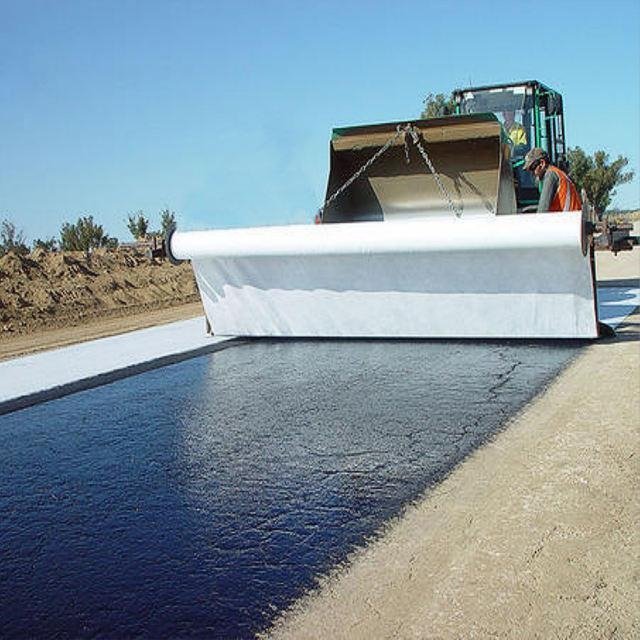
A nonwoven geotextile can be installed beneath the geomembrane where additional puncture protection is required.

The appropriate geotextile weight and mechanical properties depend on:

  • Subgrade conditions
  • Aggregate size
  • Geomembrane thickness
  • Expected construction loads
  • Project specifications

For example, 200g/m² nonwoven geotextile can be considered for some protection applications, while heavier geotextiles may be appropriate for more demanding conditions.

3.3 Measure, Plan, and Cut the HDPE Liner

After the subgrade has been approved, the installation team can begin panel layout.

Recommended practices:

  1. Confirm field dimensions.
  2. Compare measurements with the approved panel layout.
  3. Determine seam locations.
  4. Account for anchor trenches and perimeter details.
  5. Minimize unnecessary overlaps and seams.
  6. Label panels for installation traceability.

HDPE geomembranes should be cut using appropriate tools that create clean and controlled edges.

Avoid unnecessary cutting directly on rough ground, since the liner can be damaged during handling.

3.4 Deploy the HDPE Geomembrane

HDPE liner deployment should be performed carefully to avoid stretching, tearing, folding, or excessive wrinkles.

During deployment:

  • Use suitable lifting and handling equipment.
  • Avoid dragging the geomembrane over rough surfaces.
  • Position panels according to the approved layout.
  • Keep equipment from driving directly on exposed geomembrane unless specifically permitted.
  • Use temporary ballast such as sandbags where necessary.
  • Avoid excessive tension during deployment.
  • Protect exposed panels from unnecessary damage.

Wind can be a major issue during geomembrane installation. Temporary ballast should be used to prevent panels from moving or lifting before they are welded and anchored.

Manage wrinkles carefully

Some thermal wrinkles are normal, particularly during hot weather. However, excessive wrinkles can create problems during seaming and cover placement.

The installation team should coordinate deployment and welding schedules with site temperature and weather conditions.

3.5 Weld the HDPE Geomembrane

The quality of geomembrane seams is critical because the liner itself can be intact while a poorly constructed seam becomes the weak point of the containment system.

Two common welding methods are:

Hot-Wedge Welding

Hot-wedge welding is commonly used to create long, continuous seams between overlapping geomembrane panels.

A heated wedge melts the contacting surfaces, which are then pressed together to form the seam.

It is especially suitable for:

  • Long straight seams
  • Large geomembrane panels
  • Factory or field welding operations

Extrusion Welding

Extrusion welding uses a heated polymer extrusion material to join geomembrane surfaces.

It is commonly used for:

  • Detail work
  • Repairs
  • Patches
  • Pipe penetrations
  • Irregular areas
  • Areas where automatic wedge welding is not practical

Trial Welds

Before production welding begins, trial welds should be performed to confirm that the selected welding parameters are appropriate for the actual field conditions.

The welding team should evaluate factors such as:

  • Temperature
  • Welding speed
  • Pressure
  • Material thickness
  • Ambient temperature
  • Surface condition

Trial welds should be tested according to the applicable project specification and test method.

3.6 Anchor the HDPE Liner

HDPE geomembranes must be properly secured around the perimeter and at other locations identified in the engineering design.

An anchor trench is one common method.

Typical process:

  1. Excavate the anchor trench according to the approved design.
  2. Place the geomembrane into the trench.
  3. Avoid excessive tension or sharp bends.
  4. Backfill with suitable material.
  5. Compact the backfill as specified.
  6. Inspect the anchoring area.

Anchor trench dimensions should not be standardized for every project. They depend on liner thickness, soil conditions, slope geometry, wind loads, and engineering calculations.

3.7 Inspect and Test the Geomembrane

Inspection should take place throughout installation rather than only after the entire liner has been completed.

Visual Inspection

Inspect the geomembrane for:

  • Cuts
  • Tears
  • Holes
  • Scratches
  • Excessive wrinkles
  • Contamination
  • Poor seams
  • Damaged areas

Seam Testing

Depending on the seam type and project specification, testing may include:

  • Air-pressure testing
  • Vacuum-box testing
  • Spark testing for suitable conductive systems
  • Destructive seam testing
  • Other project-specific non-destructive testing

For example, double-track fusion seams can be evaluated using air-pressure testing where the seam configuration permits it.

Extrusion-welded areas can often be evaluated using vacuum-box testing or other appropriate methods.

Destructive Testing

Selected seam samples may be removed and tested to evaluate properties such as:

  • Shear strength
  • Peel strength

Testing should follow the applicable project requirements and recognized test methods.

All defective areas should be clearly marked, repaired, and retested.

3.8 Install Protective and Cover Layers

After the geomembrane has passed the required inspection and testing, additional layers may be installed according to the project design.

Depending on the application, these may include:

  • Protective geotextile
  • Drainage geocomposite
  • Sand
  • Soil
  • Gravel
  • Concrete
  • Other engineered cover materials

Avoid damaging the geomembrane

Cover placement is another stage where geomembrane damage can occur.

The installation team should:

  • Avoid dropping large rocks directly onto the liner.
  • Prevent sharp aggregate from penetrating the geomembrane.
  • Use appropriate equipment and access methods.
  • Follow the specified cover thickness and placement sequence.
  • Avoid unnecessary traffic over exposed geomembrane.

For composite liner systems, the protection and drainage layers should be installed according to the approved cross-section.

3.9 Final Inspection and Documentation

The final stage is to verify that the completed liner system meets the project requirements.

Documentation may include:

  • Panel layout drawings
  • Seam maps
  • Welding records
  • Trial weld results
  • Non-destructive test records
  • Destructive test results
  • Repair records
  • Material certificates
  • Inspection reports
  • As-built drawings
  • Photographic records

Good documentation provides traceability and makes future inspection, maintenance, and project acceptance easier.

4. Tools and Equipment for HDPE Liner Installation

The exact equipment depends on the size and complexity of the project.

Site Preparation

  • Excavator
  • Grader
  • Compactor
  • Rake
  • Shovel
  • Survey equipment

Geomembrane Handling

  • Lifting equipment
  • Spreader bars
  • Roll handling equipment
  • Sandbags or temporary ballast

Welding

  • Automatic hot-wedge welder
  • Extrusion welder
  • Generator
  • Welding accessories
  • Cleaning materials
  • Trial-weld equipment

Inspection and Testing

  • Air-pressure testing equipment
  • Vacuum box
  • Spark tester where applicable
  • Tensile testing equipment
  • Measuring tools
  • Inspection checklist

Safety Equipment

  • Safety helmet
  • Gloves
  • Safety footwear
  • Protective eyewear
  • High-visibility clothing
  • Appropriate site-specific PPE

5. Best Practices for HDPE Liner Installation

Choose the Correct Geomembrane

Do not select an HDPE liner based only on price.

Consider:

  • Thickness
  • Smooth or textured surface
  • Mechanical requirements
  • Chemical exposure
  • UV exposure
  • Subgrade conditions
  • Slope requirements
  • Welding characteristics
  • Project specifications

Prepare the Subgrade Properly

A good geomembrane installation starts with a good foundation.

The subgrade should be:

Stable + Smooth + Clean + Properly Compacted

Where the site contains sharp or coarse materials, an appropriate geotextile protection layer may be required.

Use Qualified Welding Personnel

Geomembrane welding requires practical experience.

Welders should understand:

  • Equipment setup
  • Temperature control
  • Welding speed
  • Pressure
  • Trial welding
  • Seam inspection
  • Repair procedures

For major projects, welding personnel should be qualified according to the project’s QA/QC requirements.

Monitor Weather Conditions

Temperature, wind, rain, humidity, and solar radiation can affect geomembrane installation and welding.

During unsuitable conditions, the installation team may need to:

  • Adjust deployment procedures
  • Modify welding parameters
  • Protect the work area
  • Delay welding
  • Re-test trial seams

The manufacturer’s installation recommendations and project specifications should always take priority.

Test Seams Systematically

Do not rely only on visual inspection.

A robust QA/QC program combines appropriate:

Visual Inspection → Non-Destructive Testing → Destructive Testing

The exact testing frequency and methods should be defined by the project specification.

6. Common HDPE Liner Installation Mistakes

1. Installing over an inadequately prepared subgrade

Sharp stones and uneven surfaces can create concentrated stresses and damage the liner.

2. Dragging the liner across rough ground

Dragging can cause scratches, tears, and other damage before welding even begins.

3. Ignoring panel layout

Poor panel planning can create unnecessary seams, difficult details, and excessive material waste.

4. Welding contaminated surfaces

Dust, moisture, mud, or other contaminants can negatively affect seam quality.

5. Skipping trial welds

Production welding should not begin without confirming appropriate welding parameters.

6. Failing to test completed seams

Visual inspection alone cannot reliably identify every seam defect.

7. Driving equipment directly over exposed geomembrane

Uncontrolled vehicle traffic can damage the liner or create excessive stress.

8. Poor anchoring

Insufficient or improperly designed anchoring can allow liner movement, particularly around exposed edges and slopes.

9. Installing cover material carelessly

Sharp aggregate, excessive equipment loads, or improper placement can damage an otherwise successfully installed liner.

7. HDPE Geomembrane + Geotextile Protection System

For many containment projects, HDPE geomembrane is not installed as an isolated product.

A typical composite system may include:

Prepared Subgrade

Nonwoven Geotextile Protection Layer

HDPE Geomembrane

Drainage / Protective Layer

Cover or Containment Material

The exact configuration depends on the project.

Why use geotextile beneath HDPE geomembrane?

A properly selected nonwoven geotextile can help provide separation and cushioning between the geomembrane and the underlying soil or aggregate.

For projects where puncture protection is a concern, the geotextile should be selected according to the actual subgrade and project loading conditions rather than simply choosing a particular GSM.

Tinhy Geosynthetics supplies both HDPE geomembranes and nonwoven geotextiles, allowing customers to develop compatible geosynthetic systems for containment and civil engineering projects.

8. How to Select an HDPE Liner for Your Project

Before requesting a quotation, prepare the following information:

Project Information What to Provide
Application Pond, landfill, mining, wastewater, reservoir, etc.
Liner material HDPE or specified material
Thickness Required thickness in mm or mil
Surface Smooth or textured
Project dimensions Length × width / total area
Subgrade Soil, concrete, gravel, rock, etc.
Slope Slope dimensions or drawings
Chemical exposure Type and concentration where applicable
Temperature Expected operating conditions
Protection layer Geotextile or other protection system
Welding Field welding requirements
Standards Applicable project specifications
Delivery Destination and preferred packaging

The more complete the project information, the more accurately the supplier can recommend the appropriate geomembrane configuration.

9. Why Choose Tinhy Geosynthetics?

Tinhy Geosynthetics has been engaged in geomembrane and geosynthetic manufacturing, installation, and R&D since 2002.

Our product range includes:

  • HDPE geomembranes
  • Textured HDPE geomembranes
  • LLDPE geomembranes
  • Composite geomembranes
  • Nonwoven geotextiles
  • Woven geotextiles
  • Geosynthetic clay liners
  • Drainage products
  • Geogrids
  • Geocells
  • Other geosynthetic solutions

For HDPE geomembranes, customers can select different thicknesses and surface configurations according to project requirements.

Quality Control

For engineering applications, consistent manufacturing quality is essential.

Tinhy operates an in-house laboratory and quality-control system for testing and product verification. The company also works with recognized third-party testing and certification organizations for relevant products and projects.

Rather than choosing a geomembrane solely according to a generic “best” ranking, project owners and contractors should evaluate:

Material Quality + Technical Data + Testing + Manufacturing Consistency + Installation Support

10. Final Checklist Before HDPE Liner Installation

Before installation begins, confirm:

☐ Engineering drawings are approved
☐ Geomembrane specifications are confirmed
☐ Panel layout is prepared
☐ Subgrade has been inspected
☐ Anchor trenches are ready
☐ Geotextile protection layer is installed where required
☐ Welding equipment has been checked
☐ Trial weld procedure is established
☐ Qualified installation personnel are available
☐ Weather conditions are suitable
☐ Testing equipment is ready
☐ QA/QC documentation is prepared

After installation:

☐ All panels are visually inspected
☐ All required seams are tested
☐ Defects are repaired and retested
☐ Cover layers are installed carefully
☐ Seam maps are completed
☐ Test records are collected
☐ As-built documentation is prepared

Frequently Asked Questions

How thick should an HDPE liner be?

There is no single thickness suitable for every application. Common geomembrane thicknesses range from approximately 0.5 mm to 3.0 mm, but the correct thickness depends on the application, subgrade, loading, chemical conditions, installation method, and engineering requirements.

Can HDPE geomembrane be installed directly on soil?

It can be installed over a properly prepared soil subgrade when the project design permits it. However, if the subgrade contains sharp particles or other conditions that could damage the liner, a geotextile or other protection layer may be required.

What is the difference between smooth and textured HDPE geomembrane?

Smooth geomembranes generally have lower interface friction and are commonly used on relatively flat surfaces. Textured geomembranes provide greater interface friction and are often selected for applications involving slopes where interface stability is important.

How is HDPE geomembrane welded?

Long field seams are commonly produced using hot-wedge or similar fusion welding equipment. Extrusion welding is frequently used for details, repairs, and areas that are difficult to weld using automatic equipment.

How are HDPE geomembrane seams tested?

Depending on the seam configuration and project specification, testing may include air-pressure testing, vacuum-box testing, spark testing for suitable conductive systems, and destructive seam testing.

Can geotextile be installed under HDPE geomembrane?

Yes. A properly selected geotextile can serve as a protective layer between the subgrade and geomembrane. The appropriate geotextile type and mass per unit area should be determined according to site and project conditions.

How long does HDPE geomembrane last?

Service life depends on factors such as resin quality, thickness, UV exposure, temperature, chemical environment, installation quality, and whether the geomembrane is exposed or covered. A project-specific service-life assessment is preferable to relying on a single generic lifespan figure.

Conclusion

HDPE liner installation is more than simply unrolling a geomembrane and welding the panels together. Subgrade preparation, panel layout, deployment, welding, anchoring, seam testing, protection, and documentation all contribute to the performance of the completed containment system.

For contractors, engineers, and project owners, the best approach is to select the geomembrane according to the actual project conditions and then establish a controlled installation and QA/QC procedure.

Tinhy Geosynthetics provides HDPE geomembranes, geotextiles, and other geosynthetic products for applications including landfills, mining, water containment, wastewater treatment, aquaculture, agriculture, and infrastructure projects.

If you have project drawings, required thickness, dimensions, application details, or technical specifications, Tinhy can help evaluate the appropriate geomembrane and geosynthetic configuration for your project.

Knowledge Base
Share:
info@tinhygeosynthetics.com Bai Jinxi
Consultation

    Get The Latest Product Prices

    Your inquiries are welcomed at any time and please feel free to contact us via email, phone calls, and online chatbox on our site.

    We will definitely give you a reply ASAP after we receive your messages.

      0/180